How to Write Core Values for Your Construction Company

Introduction
Values Are Your Operating System
Feel like you’re always hiring the wrong people? Are they making choices that don’t match your expectations, or unable to make decisions on their own? It’s not bad luck — it’s a sign that you need more effective company values.
But most companies go about them the wrong way. They throw a few buzzwords on a slide and call it a day. The result? Values that are ignored, forgotten, or worse — they feel forced. Instead of inspiring your team, they can actually drive a wedge between the field and leadership.
Values are the operating system for your team. They define the standard for your company culture and how every employee is expected to act, regardless of their tenure or job title. This guide is here to help you write values that help you hire the right people on the first try instead of replacing the wrong ones. They’ll also help you spend more time giving praise and less time providing corrective action. We’ll cover the do’s, don’ts, and how partnering with a branding and marketing agency can turn a messy process into something meaningful.
Tip One
Do: Write Values That Solve Real Problems
Core values aren’t fluff — at least, they shouldn’t be. The reason many people roll their eyes at company values is because they’ve seen too many lists of vague, feel-good words that aren’t rooted in reality or don’t solve real cultural problems.
Whether you’re just starting out, growing quickly, merging teams, or trying to get your culture back on track, values should directly address the real challenges you face.
Let’s say trust is a problem. Maybe crews are pointing fingers instead of owning mistakes. Or maybe safety protocols are getting skipped to hit deadlines. A well-defined set of values, regularly communicated and reinforced by managers, can be a powerful tool for correcting course.
Remember, the right values:
- Help you hire the right people and keep the wrong ones out.
- Inspire more of the behaviors you want and less of the ones you don’t.
- Give your team a common language for how they operate.
Pro tip: Think about the cultural challenges you’re facing now, and write one value to help address each one.
Tip Two
Don’t: Use Generic Values That Could Belong to Anyone
“Hard Work.” “Safety.” “Communication.”
We see these everywhere, and there’s nothing wrong with them in theory. In fact, hard work, safety, and communication are all important to instill. But in practice, they don’t mean much unless you define them. Why?
Because:
- They’re overused in our industry.
- They mean different things to different people.
- They don’t give your team clear direction.
For example:
- Instead of “Hard Work,” say: “Earn It Every Day.”
- Instead of “Safety,” say: “Protect the Crew.”
- Instead of “Communication,” say: “Connect Early and Often.”
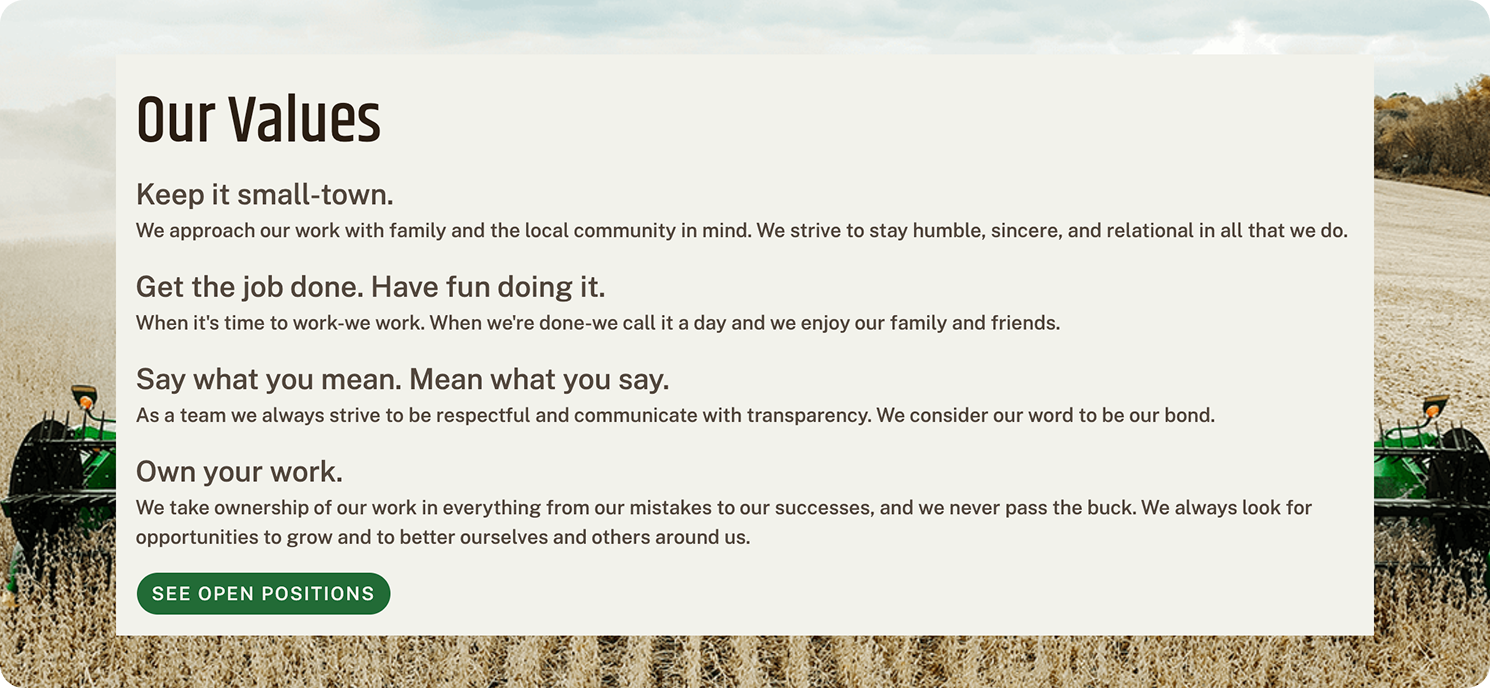
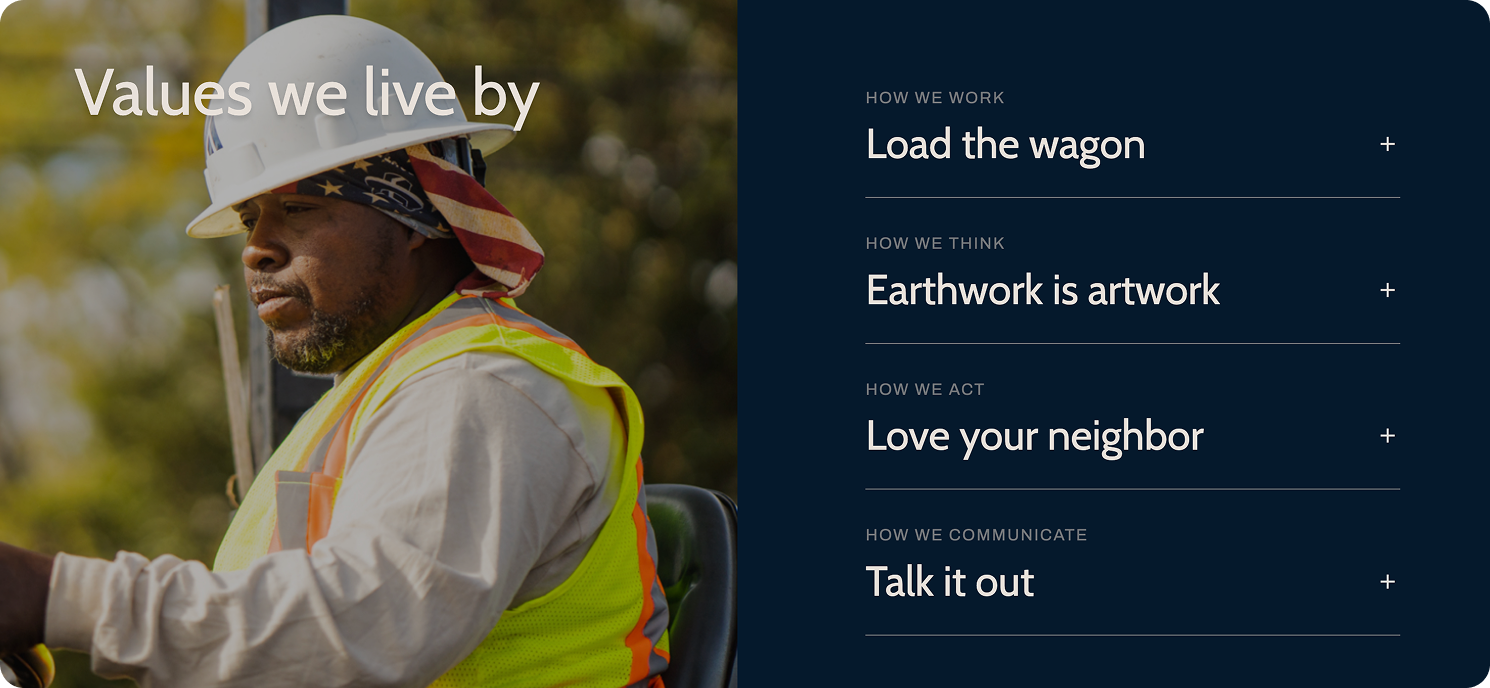
From utility contractors and equipment dealers to demolition companies and heavy civil contractors, Fieldwrk helps companies in essential industries write values that feel authentic and resonate across teams. As examples, check out the values we helped Midwest Machinery (top) and Abernathy Contracting (bottom) to create:
Pro tip: Say the value out loud. If it sounds like something any company would say, you haven’t made it your own yet.
Tip three
Do: Reflect Who You Are Today — And Who You Want to Be
Here’s a common question we get at FieldWrk: Should our values reflect who we are or who we aspire to be?
The answer: both.
If your current team has strengths worth celebrating, build around them. But if you’re trying to raise the bar, don’t be afraid to define values that push people forward.
Let’s say everyone does a great job at maintaining clean jobsites. You could honor that, and instill the behavior in new hires, with a value like “Keep It Clean.”
Now think about areas for improvement. If rushed work and cutting corners are an issue, a new value like “Do it right the first time” can help lead the way by encouraging workers to take time to check their work instead of fixing it later.
Avoid writing values that are too abstract or sound like they came from a seminar. “We strive for excellence” is a vague aspiration. But the ones above are both a mirror and a map. A good value reflects your current reality while setting a standard for your future.
Pro tip: Ask yourself, "What do we praise our team for doing? What do we wish we saw more of?"
Tip four
Don’t: Make It a Top-Down Exercise
Values written exclusively by leadership can run the risk of sounding disconnected from what happens in the field. Not because leadership is out of touch, but because people in the field don’t always speak the same language as the execs.
Example: “We foster innovation through collaboration.”
Sounds nice. But what does that mean to a laborer or a foreman trying to hit a deadline? Instead, build your values with your team, not just your leaders. That’s not to say leadership doesn’t have valuable insight — they do. But values are stronger when they’re built from both sides. Here’s how you can bring them together:
- Hold a few group sessions with field crews and project teams.
- Learn what makes your people proud to work there.
- Ask what makes a teammate reliable or what behaviors hurt a project.
Your crews might not care about buzzwords, but they care about being heard. And when they help create the values, they’re more likely to live them. Values aren’t about controlling behavior — they create the type of culture that inspires it naturally.
Pro tip: Try going into the field and asking crews these questions:
- Do you share any catchphrases or sayings?
- What does safety look like?
- How do you hold one another accountable?
Don’t be afraid to incorporate these into your values so they feel born in the field.
Tip five
Do: Make Your Values Actionable
Every day on the job, your team makes decisions. Some big, others small. There’s not always a manager around to give input. That’s where strong values come in — they empower your team with the confidence to make better decisions.
Think of them as built-in guardrails. They help someone act (and react) even when the situation is new, because they can always fall back on their values. Vague values like "Be Professional" might not be that helpful. But something like “Show Up Ready and Respectful” sets a clear and actionable standard of professionalism.
Ask yourself:
- Can a new hire understand what this value means without explanation?
- Is it applicable for all roles within the company?
- Can you recognize someone for living it?
Avoid vague concepts and write values as if you’re writing instructions. Clear, strong, and behavior-driven.
Pro tip: If your value can’t help someone make a tough decision on their own, it’s not specific enough.
Tip six
Do: Set Clear Expectations for Each Value
A value without context is subject to different interpretations, and you need to make sure everyone is on the same page.
If you want your team to understand what a value actually means, spell it out with a short description. And even better, a list of specific behaviors.
This is how you could build out the sample values from earlier:
- Value Idea: Hard Work
- Value Title: “Earn It Every Day”
- Description: We show up with grit, humility, and a drive to outwork yesterday.
- This looks like:
- Taking initiative instead of waiting to be told
- Leaving no doubt that you gave the day your best
- Staying focused and pulling your weight from start to finish
- Value Idea: Safety
- Value Title: “Protect the Crew”
- Description: We stop work before we put anyone at risk.
- This looks like:
- Speaking up when something doesn’t look safe
- Checking on teammates and making sure everyone gets home in one piece
- Following safety protocols every time (not just when leadership is around)
- Value: Communication
- Value Title: “Connect Early and Often”
- Description: We don’t wait to speak up. Clear, early communication keeps projects and relationships on track.
- This looks like:
- Picking up the phone before a small issue becomes a big problem
- Looping in the right people instead of assuming someone else will
- Giving updates even when there’s “nothing new” to report
This is your operating system. Build it to be useful.
Pro Tip: Turn each value into a mini training moment. Use real-world examples during onboarding to bring them to life.
Tip seven
Do: Keep It Short & Stick to 3-6 Values
You don’t need a dozen values. You need a handful that matter. Having three values that everyone knows and acts on is better than twelve that nobody can remember or care to look for on your website.
Too many, and people won’t remember them. Too few, and they won’t cover enough ground. The sweet spot? Three to six values. Enough to guide your team without overwhelming them.
Your values should work together, too. Like puzzle pieces forming a picture of what a great employee looks like. A helpful exercise to capture a holistic view is to think of your value system as answers to these questions:
- How do we work?
- How do we think?
- How do we act?
- How do we communicate?
- How do we connect?
- How do we grow?
Pro Tip: Ask your team to name your values from memory. If they can’t, there are probably too many or they are too complicated.
Tip eight
Do: Use Your Values in Hiring, Onboarding, and Recognition
Your values should show up before someone’s first day on the job — and every day after. They should guide how you recruit, train, and reward your team. Used consistently, values become a lens for accountability and encouragement.
Recruiting & Hiring
Ask interview questions that test alignment with your values. You’re not just looking for skills — you’re screening for cultural alignment.
- For example, if one of your values is “Own the Outcome,” you might ask: “Tell me about a time you made a mistake at work. What did you do next?”
- Or, if your value is “Protect the Crew,” ask: “How do you handle safety when you’re under pressure to meet a deadline?
Onboarding
Explain your values clearly. Don’t just list them in a welcome packet — tell the stories behind them.
- Involve team members who embody your values to help onboard new hires.
- Discuss how your values apply to interactions with clients and the company’s public reputation, not just office culture.
Recognition
One of the best ways to reinforce your values is by celebrating them.
Recognition reinforces the behaviors you want to see more of. Over time, this builds a culture of accountability and pride. People begin to associate your values not with posters or PowerPoints, but with how real people work and lead.
Try:
- Monthly core value awards delivered from leadership
- A peer-nominated “Values MVP” on each crew
- Including values as part of performance reviews
If your values don’t show up in the way you work, they’re not working.
Tip nine
Do: Make Your Values Visible and Real
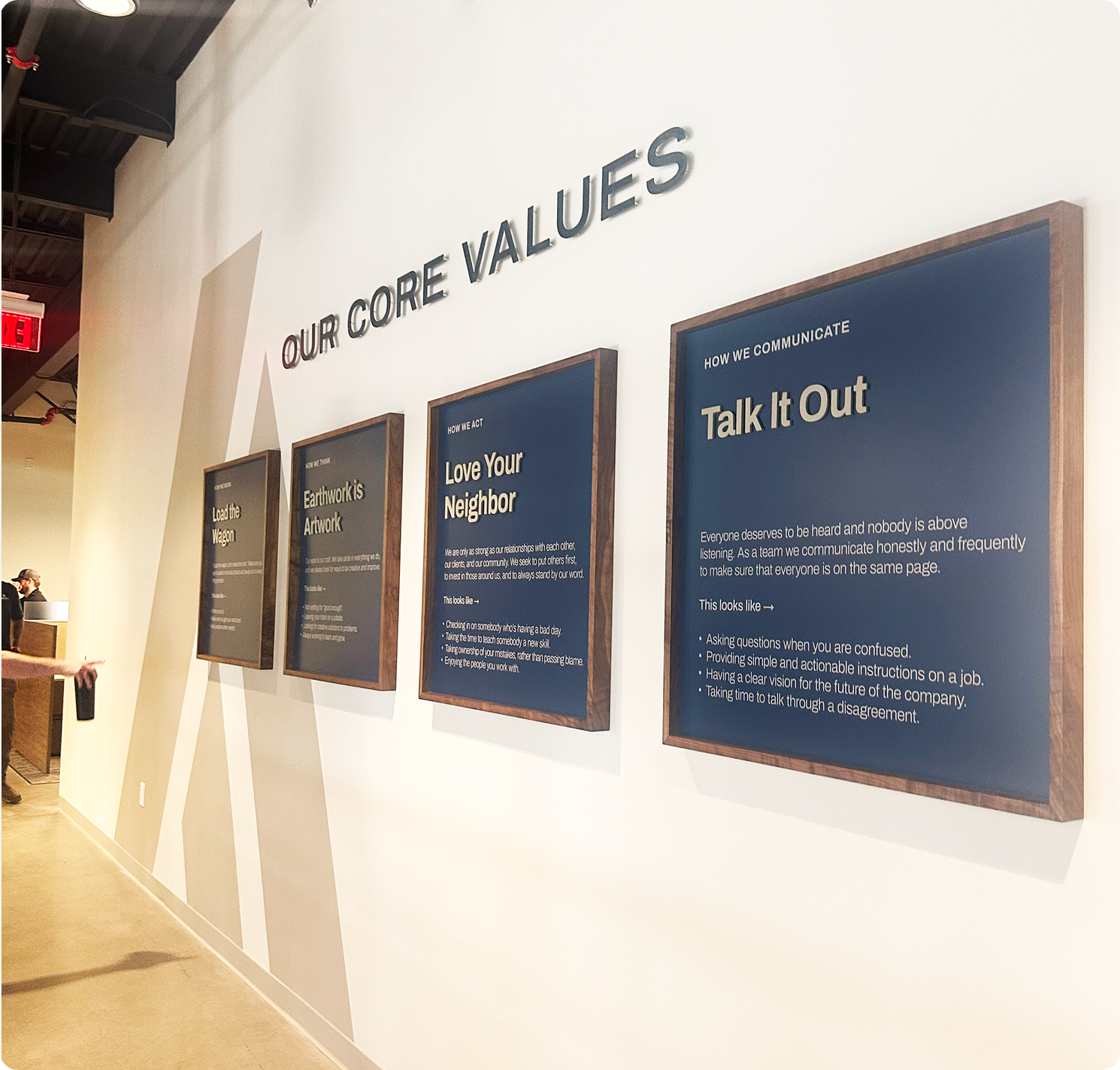
Values aren’t meant to be tucked away. To make them real, you have to make them visible. This isn’t just about branded decor in the office — it’s about repetition. The more your team sees the values, the more they remember them. The more they remember them, the more they’ll start to align with them (or see themselves out if they don’t).
Here are easy ways to make your values visible:
- Display them in your office, break room, or shop
- Add them to onboarding decks and training sessions
- Turn them into stickers for hard hats and computer equipment
- Print them on t-shirts or other company merch
- Put them on the careers page of your website
- Include them in job postings
It might feel a little awkward at first. But over time, it becomes ingrained in your culture. And you’ll start to see the shift: new hires showing up aligned, team members holding each other accountable, leaders using the values to make decisions. That’s culture. But you can’t get there without visibility.
Tip ten
Do: Revisit & Refresh Over Time
Your company will change. Your values should keep up.
We recommend reviewing your core values every year during annual planning to ensure they are aligned, especially after:
- A major leadership shift
- A merger or acquisition
- A new market or service launch
- Rapid team growth
If a value no longer reflects how you operate, update it. A value losing its relevancy doesn't mean you’ve failed — it is often a sign of growth, maturity, and opportunity.
Pro Tip: Add a values review to your strategic planning cycle. It keeps them relevant and helps you stay on top of cultural shifts within your company.
Conclusion
You Can Certainly Write Values Yourself — But Should You?
After helping 75+ B2B companies in the industrial and construction sectors clarify their vision, mission, and values, we’ve found that having an experienced, objective facilitator can be helpful. When you’re too close to the heart of it all, it can be difficult to see the forest for the trees.
That’s where we come in.
At Fieldwrk, we help blue collar companies write values that actually work. Not corporate fluff. Here’s how:
- Field surveys and interviews: We talk to your team (including those in the field) to find the language that already exists in your culture.
- Expert copywriting: We turn rough ideas into bold, clear values that’ll make you say, “I wish I had thought of that.”
- Strategic alignment: We connect your values to your brand, hiring goals, and growth plan, so they’re not just meaningful but also marketable.
Most importantly, we act as an objective partner. We help leadership teams avoid groupthink, facilitate tough conversations, and bring structure to what often feels like an aimless, never-ending discussion.
Bonus: Values are often just one part of a bigger rebrand. If you’re overhauling your messaging, FieldWrk can help tie everything together.
If you want values that are built to last, and actually used, reach out to Fieldwrk. We’ll help you cut through the fluff and create a set of values your team will be proud to stand behind.